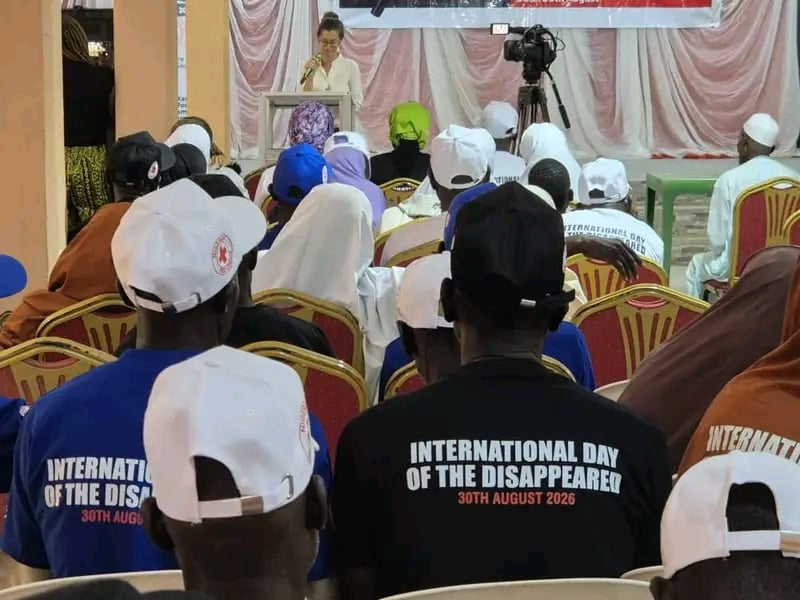
Families of people who disappeared during years of insurgency and armed conflict in Nigeria’s North-East have renewed calls for stronger efforts to trace their loved ones and provide answers about their whereabouts.
The families made the appeal during activities in Yola, Adamawa State, marking the 2026 International Day of the Disappeared. The programme provided an opportunity for relatives of missing persons to share their experiences, remember loved ones and draw attention to the prolonged uncertainty they continue to face.
For many of the families, the disappearance of a relative has created a painful situation in which they cannot fully mourn, rebuild their lives or know what the future holds. Some have spent years searching for information while continuing to hope that their missing relatives may still be alive.
The International Committee of the Red Cross (ICRC) says about 17,000 missing-person cases are currently under active tracing in Nigeria. The organisation said the figure represents cases being actively followed as of July 2026 and is subject to change as families are reunited, new cases are registered or existing cases are resolved.
Adamawa remains one of the states significantly affected by the crisis. About 3,000 of the cases being documented by the ICRC are linked to the state.
Families continue to live with uncertainty
Relatives said the emotional impact of disappearance extends beyond the initial incident. Families often struggle with financial difficulties, disrupted education, psychological distress and the absence of breadwinners.
Some families were themselves displaced by the insurgency and have had to rebuild their lives in unfamiliar communities while continuing to search for missing relatives.
One of the affected relatives, Habiba Mustapha, has previously described the disappearance of four members of her family as a continuing source of emotional and economic hardship. Her experience reflects the difficulties faced by families who have lost relatives without receiving confirmation of what happened to them.
Calls for stronger tracing efforts
The families have urged government authorities, humanitarian organisations and other stakeholders to strengthen efforts to locate missing persons and reconnect them with their relatives.
They also want greater institutional support for families who have spent years dealing with the consequences of disappearance.
The families argue that every missing person represents more than a statistic or case number. Each case involves a human being whose absence continues to affect parents, spouses, children, siblings and wider communities.
The 2026 activities in Adamawa included awareness and remembrance initiatives designed to keep the issue of missing persons in the public consciousness. Similar activities have included community sanitation exercises, where relatives used the occasion to remember their loved ones and advocate for renewed tracing efforts.
Humanitarian impact remains significant
The ICRC has emphasised that the issue of missing persons creates consequences that go beyond the search itself. Families may face uncertainty, loss of income, administrative and legal difficulties and significant psychological pressure.
The organisation continues to work with families to restore contact where possible, establish the fate and whereabouts of missing people and support affected relatives.
The ICRC has also stressed that the current figure of 17,000 represents active cases being traced rather than a definitive count of every person who may be missing in Nigeria. Some families have become difficult to reach because of displacement, changes in contact information and security or logistical challenges.
Hope remains central
Despite the years of uncertainty, families in Adamawa say they have not abandoned hope of receiving answers.
Their message during the gathering was that the disappearance of their relatives should not be forgotten and that sustained efforts are needed to establish what happened to those who remain unaccounted for.
For the affected families, finding missing persons is not simply a humanitarian exercise. It is a matter of restoring family connections, obtaining closure and ensuring that those who disappeared during Nigeria’s years of conflict are not reduced to forgotten statistics.