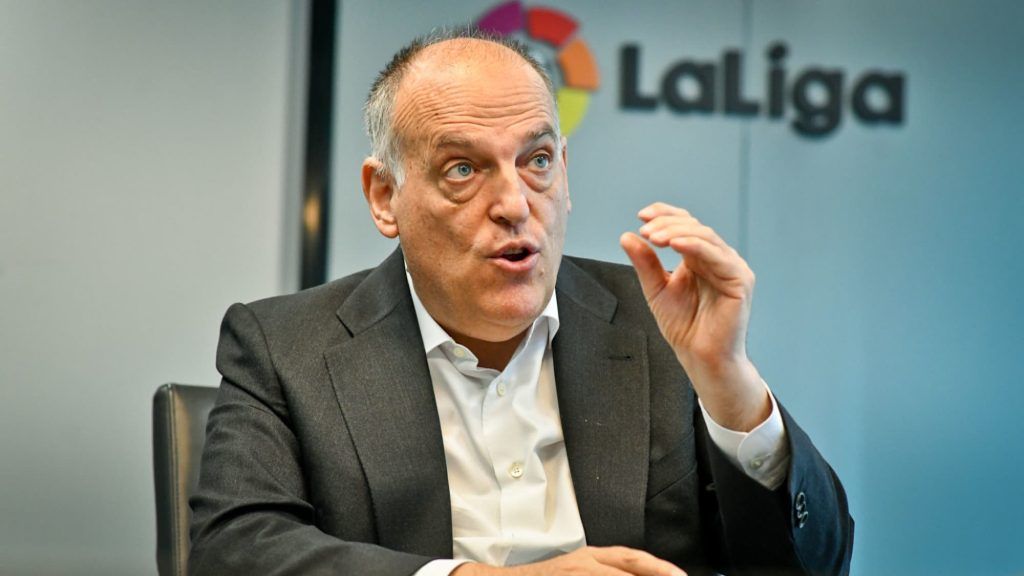
Spanish football giants Real Madrid have demanded the immediate resignation of LaLiga president Javier Tebas following controversial comments in which he compared the club’s communication methods to propaganda techniques used by Nazi Germany.
The club condemned the remarks as offensive and unacceptable, arguing that they demonstrated a lack of neutrality, respect and impartiality expected from someone occupying a senior leadership position in Spanish football.
In a statement released on Friday, October 16, 2026, Real Madrid called on Tebas to step down as president of LaLiga and as vice-president of the Royal Spanish Football Federation (RFEF).
The latest confrontation has intensified the long-running dispute between the club and the head of Spain’s top professional football league, raising fresh questions about leadership, institutional neutrality and the relationship between football authorities and their member clubs.
Controversial Comments Spark Outrage
The dispute erupted after Tebas criticised the communication strategy employed by Real Madrid’s management and its official television channel, Real Madrid TV.
The LaLiga president accused the club’s leadership of repeatedly highlighting refereeing decisions it considered unfavourable, reinforcing complaints and creating suspicion about the conduct of match officials.
In his comments on social media, Tebas compared these communication methods to techniques associated with Joseph Goebbels, the propaganda minister of Nazi Germany during the Second World War.
Tebas subsequently clarified that his comparison concerned propaganda techniques rather than Nazi ideology or Real Madrid supporters.
However, the club rejected the explanation, maintaining that invoking the Nazi regime in connection with its management and media operations was deeply offensive and inappropriate for a football administrator holding such influential positions.
Real Madrid Accuses Tebas of Lacking Neutrality
In its response, Real Madrid described Tebas’s remarks as extraordinarily serious and incompatible with the responsibilities attached to his institutional positions.
The club argued that the LaLiga president had repeatedly made statements it considered hostile towards Real Madrid, its leadership and its media operations.
According to the club, a football administrator responsible for overseeing a major professional competition must demonstrate fairness, neutrality and respect towards all participating teams.
Real Madrid maintained that Tebas’s conduct had undermined confidence in his ability to discharge those responsibilities impartially.
The Spanish club consequently demanded his immediate resignation, insisting that his continued leadership was incompatible with the principles expected of a football governing official.
Long-Running Dispute Over Refereeing Decisions
The latest controversy comes amid an ongoing disagreement between Real Madrid and LaLiga over refereeing decisions and the way the club publicly discusses match officials.
Real Madrid TV has regularly reviewed controversial incidents involving referees, highlighting decisions the club believes have negatively affected its performances.
Tebas has criticised this approach, arguing that repeated public complaints can fuel distrust and damage confidence in Spanish football’s officiating system.
Real Madrid, however, has defended its right to scrutinise refereeing decisions and demand greater transparency in the administration of the sport.
The disagreement reflects a broader struggle over how clubs, league administrators and media organisations should address contentious officiating decisions without undermining the credibility of competitions.
The relationship between Real Madrid president Florentino Pérez and Tebas has also been strained by disagreements over the direction and administration of Spanish football.
Negreira Case Adds to Institutional Tensions
Real Madrid also raised concerns about the handling of the Negreira case, which centres on payments made by FC Barcelona to companies linked to José María Enríquez Negreira, a former vice-president of Spain’s Technical Committee of Referees.
The case has generated significant controversy within Spanish football and prompted calls for greater transparency concerning the relationship between clubs and refereeing institutions.
Real Madrid has argued that the matter requires a thorough and transparent investigation. The club has also questioned the response of football authorities to the allegations.
The payments and their implications have been the subject of legal scrutiny. However, the existence of the payments should not, by itself, be treated as proof that referees were improperly influenced or that matches were fixed.
Real Madrid’s concerns over the case have contributed to its wider criticism of football governance in Spain and its calls for institutional reforms.
Tebas Faces Renewed Pressure
Tebas, who has served as LaLiga president since 2013, has repeatedly faced criticism from Real Madrid over his leadership and public comments concerning the club.
The latest demand for his resignation represents another escalation in the dispute between the two parties.
Real Madrid wants a football administration that it believes can guarantee impartiality, transparency and accountability across Spanish professional football.
However, a demand for resignation does not automatically mean that Tebas will leave office. Any leadership change would have to follow the applicable governance and election procedures.
As of October 17, 2026, the public dispute has intensified, but no resignation has been confirmed in connection with Real Madrid’s latest demand.
The controversy is likely to keep relations between the club and LaLiga under pressure as both sides defend their positions.
Conclusion
Real Madrid’s demand for the immediate resignation of Javier Tebas has opened another chapter in its prolonged confrontation with LaLiga’s leadership.
At the centre of the dispute are Tebas’s controversial comparison of the club’s communication methods to Nazi-era propaganda techniques, Real Madrid’s accusations of institutional bias and continuing disagreements over refereeing and football governance.
While Tebas maintained that his comparison concerned communication methods rather than Nazi ideology, Real Madrid insisted that the remarks were unacceptable and incompatible with his responsibilities.
Whether the confrontation will lead to any change in LaLiga’s leadership remains uncertain. For now, the dispute highlights the continuing tensions between one of Spain’s most successful football clubs and the administrator responsible for overseeing its domestic league.