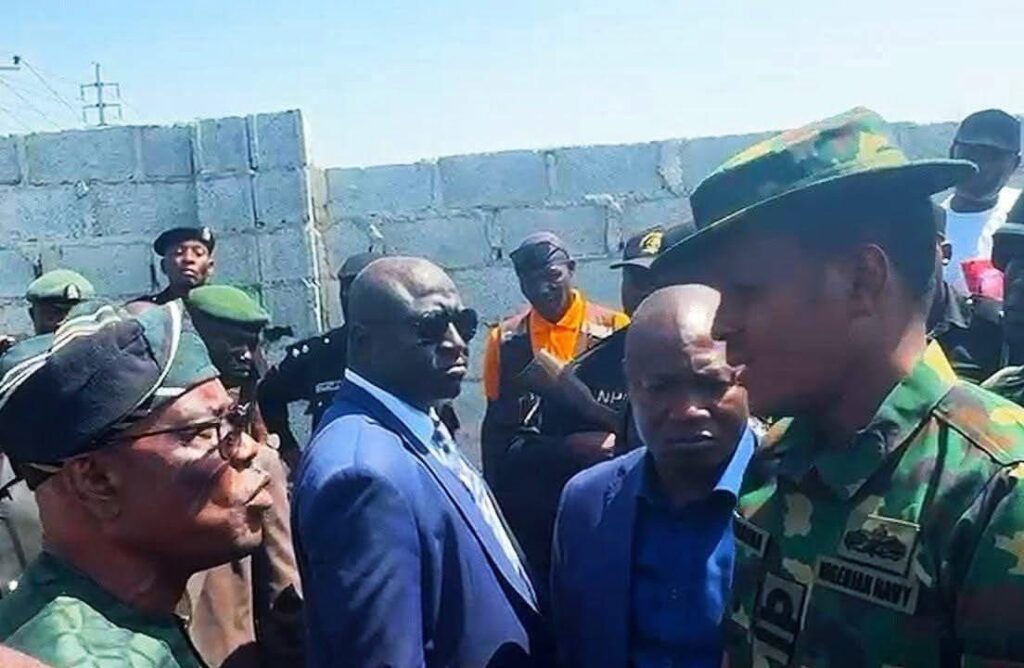
A dramatic confrontation between Nigeria’s Minister of the Federal Capital Territory (FCT), Nyesom Wike, and a military officer in Abuja has sparked intense national debate, drawing reactions from politicians, veterans, civil society groups, and ordinary Nigerians. The incident, which was caught on video and quickly went viral, has become a flashpoint for discussions about power, respect for institutions, and the limits of authority in public service.
The clash took place during an official inspection and enforcement operation led by Minister Wike in the Gaduwa area of Abuja. The FCT Administration had reportedly marked several buildings in the area for demolition over issues related to illegal land development and lack of approved documentation.
When Wike and his team arrived at one of the disputed sites, they encountered armed military personnel stationed around the property. The soldiers, acting on the orders of their superiors, refused to grant the minister’s team access to the compound, insisting that the property was legally acquired and protected.
This resistance triggered a heated exchange between Wike and one of the uniformed officers. In the viral video, Wike could be seen visibly angered, questioning the officer’s authority to obstruct an official FCT operation. The altercation escalated when Wike accused the soldiers of aiding illegal developers and undermining civil authority.
At one point, Wike reportedly said,
“You can’t intimidate me. You are supposed to protect the law, not those breaking it. This is the capital city; you don’t build without approval.”
The military officer, maintaining composure, defended himself by stating that he was only carrying out orders and that the property was legally owned and documented. He added,
“I’m an officer with integrity, sir. Everything here was acquired legally.”
Wike, however, insisted that no document was presented to the FCTA and ordered that construction activities be halted until proper verification was done.
The confrontation, filmed by several bystanders, spread rapidly across social media platforms. Within hours, the video became one of the most discussed topics in the country, with hashtags referencing #WikeVsSoldier and #AbujaClash trending widely.
The incident divided public opinion:
- Supporters of Wike hailed him for standing firm against what they perceived as abuse of military privilege and illegal land use. Many praised his courage and consistency in enforcing Abuja’s urban laws without fear or favor.
- Critics, however, accused the minister of being arrogant and disrespectful toward the military, arguing that his choice of words and tone were unbecoming of a senior government official.
The clash drew responses from a wide range of stakeholders:
- Military Veterans and Security Analysts
Retired officers and veterans condemned the public humiliation of a serving officer, stressing that the military uniform represents national honor and should not be ridiculed by a civilian leader. They argued that disputes between ministries and military institutions should be handled through formal communication channels, not public confrontations. - Civil Society and Legal Experts
Human rights advocates and legal commentators noted that while Wike had the right to enforce FCT regulations, his method reflected a breakdown in inter-agency coordination. They emphasized that both civil and military institutions must operate within the rule of law, and that the altercation underscored the need for clearer boundaries between civilian authority and military roles in non-security matters. - Political Commentators
Politicians and analysts saw the episode as a reflection of Wike’s assertive leadership style—a continuation of his confrontational approach from his time as governor. Some argued that while his firmness brings discipline, his temper sometimes risks overshadowing his achievements. - Public Sentiment
Across social media, Nigerians expressed mixed feelings. Some saw Wike’s outburst as a necessary show of courage against the misuse of power, while others felt embarrassed that a government official and a military officer would engage in such an open quarrel. Memes, debates, and street discussions turned the incident into a symbol of Nigeria’s ongoing struggle between authority, ego, and accountability.
At the heart of the clash lies a larger conflict between civil governance and the influence of security institutions in civilian affairs. The incident highlighted:
- The blurred lines between military involvement in civilian property matters.
- The persistent challenge of illegal land acquisition in Abuja, where politically connected individuals or agencies sometimes claim land through questionable means.
- The difficulty of enforcing regulations when uniformed personnel are attached to private developments.
The FCT Administration later clarified that the operation was part of its ongoing efforts to restore order to Abuja’s city planning system and reclaim lands occupied without approval. Wike reaffirmed that no one—regardless of rank or status—is above the law.
The event has reignited a nationwide conversation about:
- Respect between institutions — how civilian authorities and the military should interact in a democratic system.
- Public accountability — whether top officials should exercise more restraint and diplomacy when representing government power.
- Urban governance and corruption — with renewed attention to how military or political influence sometimes shields illegal developments from scrutiny.
Observers warn that unless the matter is handled carefully, it could strain civil-military relations and set a worrying precedent for how future inter-agency disagreements are resolved.
The clash between Wike and the military officer goes beyond a personal quarrel—it reflects deeper tensions within Nigeria’s governance structure, where authority, pride, and institutional boundaries often collide. Whether viewed as a bold defense of law or a lapse in decorum, the incident has forced the country to confront key questions about leadership conduct, institutional respect, and the delicate balance between civilian power and military presence in public life.