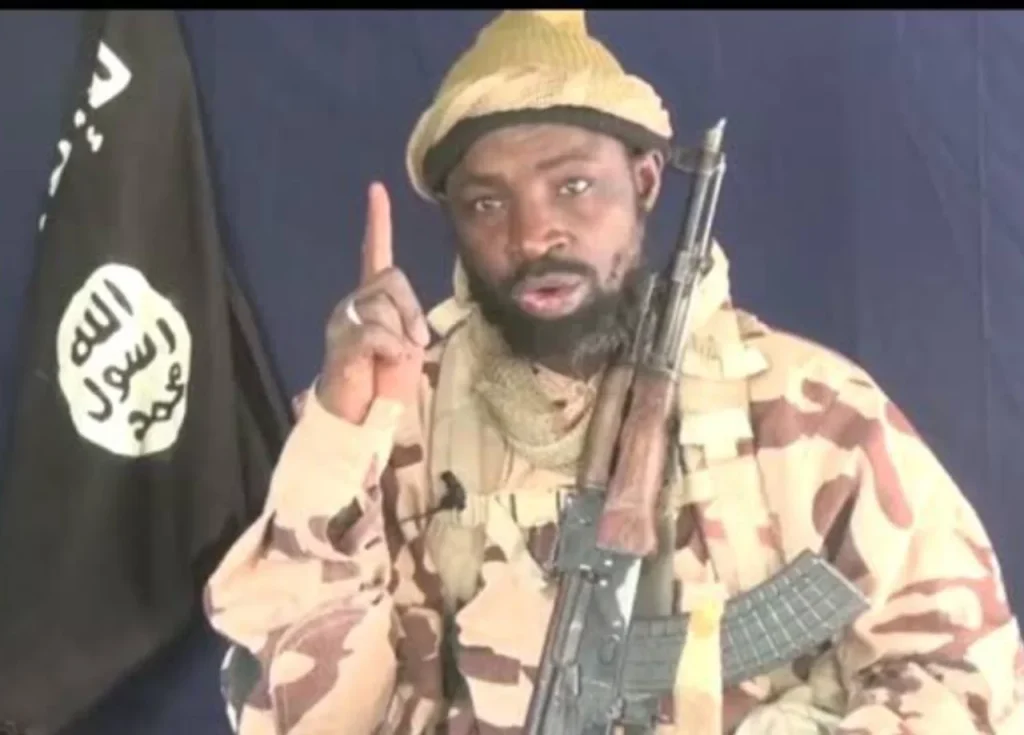
Fresh concerns over the future of the Boko Haram insurgency have emerged following reports that a son of the late Boko Haram leader, Abubakar Shekau, may have become associated with the terrorist group.
The reported development has attracted attention because of Shekau’s historical role in the insurgency and the influence he exerted over Boko Haram’s fighters during his years as the group’s most prominent leader. Shekau was killed in 2021 during a confrontation with the Islamic State West Africa Province (ISWAP), according to widely documented accounts.
Shekau’s leadership was marked by an escalation of violence across northeastern Nigeria. Under his command, Boko Haram became associated with attacks on communities, security personnel and educational institutions, as well as kidnappings and other forms of violence.
The emergence of a member of his family within the insurgency would therefore raise questions about whether elements of his ideology and influence could continue through a younger generation.
However, the reported identity and precise role of the individual said to be Shekau’s son remain matters requiring careful verification. There is a significant distinction between being related to a former insurgent leader and holding an operational or leadership position within a terrorist organisation.
Boko Haram’s Fragmented Structure
Boko Haram has undergone significant fragmentation over the years. A major split occurred after the group pledged allegiance to the Islamic State, eventually producing the faction known as ISWAP, while Shekau remained associated with the faction commonly identified as Jama’atu Ahlis Sunna Lidda’awati wal-Jihad (JAS).
The rivalry between the factions has involved both ideological disagreements and violent clashes. Consequently, any report concerning the emergence of a new figure within the insurgency must also be considered against this complicated organisational background.
Why the Development Matters
Security analysts are likely to be particularly interested in whether the reported individual has merely been drawn into the insurgency or is being positioned for a more significant role.
If confirmed as an active member, the development could demonstrate how extremist networks continue to recruit and maintain influence despite the deaths or displacement of prominent commanders.
It could also have symbolic significance. Shekau was one of the most recognisable figures associated with Boko Haram, and his name remains closely connected to some of the most devastating episodes of the insurgency.
Nevertheless, family lineage alone does not establish leadership, operational capability or ideological authority within Boko Haram. Those claims would require independent confirmation from credible security sources.
Continuing Security Challenge
The reported development comes against the backdrop of continuing insecurity in northeastern Nigeria and the wider Lake Chad Basin. Boko Haram and ISWAP have remained significant security concerns in the region, despite years of military operations and counter-insurgency efforts.
The insurgency has caused extensive loss of life, displacement and disruption to communities across northeastern Nigeria. The persistence of armed factions demonstrates that eliminating individual commanders does not necessarily eliminate the networks, grievances, recruitment structures and operational capabilities that sustain an insurgency.
For Nigerian security agencies, any confirmed emergence of a new generation of commanders or recruits connected to established militant networks could therefore require close monitoring.
For now, the reported involvement of Shekau’s son should be treated as an allegation pending authoritative confirmation of his identity, affiliation and actual role within the insurgency.