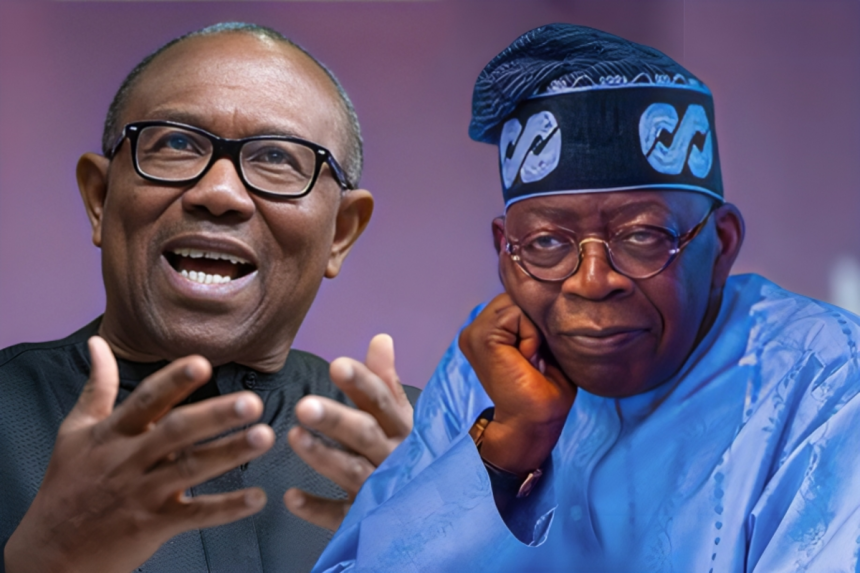
In the first nine months of President Bola Tinubu’s administration, Nigeria’s public revenue has seen an unprecedented jump, with the federal government reporting a 41 % increase in tax collections. Yet, with the inflation rate at 13.9 % and a growing debt burden, ordinary Nigerians are arguing that the sky‑high tax hikes have left them “gasping for air” – a sentiment that the opposition’s former governor of Anambra, Peter Obi, seized on in a series of fiery remarks during an interview on *The Nigerian Mirror.
Where the Money Comes From The new administration introduced a package of tax reforms last March, consolidating what; several excise duties and a revised capital gains tax, along with a hefty push for better enforcement of value‑added tax (VAT). According to the National Income and Product Account 2025, federal tax receipts climbed from ₦5.1 trillion in 2024 to ₦7.2 trillion in 2025. More strikingly, the budget deficit narrowed from 10.4 % of GDP to 8.6 % of GDP, the government’s claim that the tax surge has “clamped the wedge of fiscal deficit under control.” But with the rise in social spending draft, the oil‑heavy republic’s dependency on non‑oil revenue remains alarmingly fragile. Analysts at the Centre for Economic Development in Lagos warn that “tax spurs in the short term *do not guarantee* long‑term sustainability unless paired with structural reforms.”
The Cost on Everyday Citizens A voice in Lagos, senior accountant Nnamdi Egbe, described the situation in stark terms: > “We’re now paying double the GST on foreign services, the gasoline surcharge is at 12 % and, with the inflation puzzle, people can’t afford even basic food. That’s why there’s no room to breathe.” For many Nigerians, the revenue boost is not felt in the wallets of families. Price indices for essential goods have lactated, with the Index of Consumer Prices (ICP) showing a 22 % rise over the last quarter. Meanwhile, wage growth, pegged at 6.5 % that year, has been eclipsed by the cost of living. Peter Obi’s appearance to protest was not merely a press-out but a continuation of his critique that “bigger taxes do not always lead to better services, especially when those taxes are not translated into concrete infrastructure improvements.”
Obi’s Counterfire Peter Obi, who served as Governor of Anambra State from 2015-2023 and was a former Vice‑President‑‑elect in 2019, reportedly used the compound *“breathe, breathe, breathe”* when describing the economic rise–fall. “The people can’t breathe when every street they cross is a price showroom, while the government keeps plotting deficits,” he said in a recorded sound bite that has already taken over popular anecdotal share. Obi, sitting at a table hours before his sustainable‑growth vision took form, highlighted that the new tax laws, while increasing short‑term cash, are failing to fund pressing needs: “It’s like we’re selling our future for a crack on the present.” He admitted that there are trade-offs between revenue generation and *citizen‑centred well‑being*. “We can take money from anybody who can afford it but if we keep carving the nation’s skull for a bigger slice of spoons,” he lamented, “At what point does the polity start dying from ‘storage mold?”^ When questioned about the impact on the *middle class*, Obi explained that the *“tax-giant is a municipal landfill of diminishing returns.”* He emphasised that the only meaningful tool for boosting social welfare “is efficient delivery.” He called for the government to reduce the uncertainty that “has left small and medium enterprise employees, laborers, and host of small investors wary about the next decade.”
Government‑Side Explanation Ketcia Yarawa, the Minister of E‑Finance and Budget (2025), conducted an emergency briefing on “tax optimisation” at FAO, Oakland. She used the term “optimization” to defend the policy that she said is “an internal streamlining of the tax burden to {self‑sustain} the national infrastructure plan to 2027.” She added: > “We illustrate that revenues have to be collected to fund the *Feeling \(\mu\)* crisis, including a $5 bn health emergency and $10‑Bbn rural‑road push. Our budgeted targets meet the quarter‑yearly water‑line expectations. The national debt is at an unprecedented low of NN 23.5 % of GDP, hence the fiscal prudence.” When cross‑examined, Yarawa gave responses heaped with assurances of *“improved transparency” and *“robust accountability.” But she also admits that the quarterly revenue figures may “understate the impact on day‑to‑day wages.” She says: > “[This] was not designed to hurt the living wage recipients – the fiscal framework has redistributed it toward essential services. We intend to keep the poverty‑line down by re‑allocation, not by reducing taxes.” The question persists: why modern Nigeria still seems to rely on *“air” (fuel) stipulations to hit from the heart?
Protests, Footsteps, and the People Kosovo court‑aligned With the emerging financial crises, the National Human Rights Commission (NHRC) organised a “same‑day mass” protest in Abuja, with 7,000 citizens chanting: *“No more air‑to‑knead the tax‑check!”*. Witness, Dr Miri Ubah, told *The Disrupter* she “felt a blanket of *tax‑fear* in every corner,” with last week’s raw climate affected poor districts reflecting heavy loads at sugar tnan tapes. She said the atmosphere at the front was bleak and ***“felt like a choke‑hold.” Street vendor Ifeoma Clogher in Ikeja risked a sudden sale to meet the price shock. “I’m losing 80 % of my revenue from NFTs to the SVAT,” she confessed, adding, “my most delicate produce dies so life dried.” Her protest was met with the nerve of 2,400 on the walk in Lanwa: “What more can this government do with your own revenue breakdown in the market? We will do whatever it takes to breathe again.”
The Future Show: Onwards or Stagnant? In a further analysis, the Nigeria Institute of Economic and Social Studies (NIESS) reported a potential drop in future savings by as much as $27 bn in the coming fiscal year should the government continue these tax policies as a baseline so that the 2026 nutrition plan starts at $38,500. *“We must find a creative alternative that does not weigh down the global payroll budget.”* The 2026 elections come on the horizon. The *National Youth Coalition predicts that *government elections are likely to see the opposition surge to 18–23% of the total votes due to tax resentment.* The next electoral motto states: “Even if you are a simple engine ready for revs, may I help on the problem of *bar‑sting* covers.” With President Tinubu’s office accommodating long‑range fiscal policies, he is scheduled to present a revised tax blueprint that ticks presidential A‑list “Budget-Free” performance on the $110bn credit question.
Final Word The actual tax growth is still beneficial if it leads to infrastructural and healthcare improvements that employ the unemployed. But for many Nigerians who feel the weight of a tax regime *burning the hope of earning,* Obi’s comment “no room to breathe” paints a bleak picture. Much will depend on whether the government can transform profits into services – or if the heat of the taxes will keep them all still. How the nation takes its breath next may decide the whole financial climate of 2026.