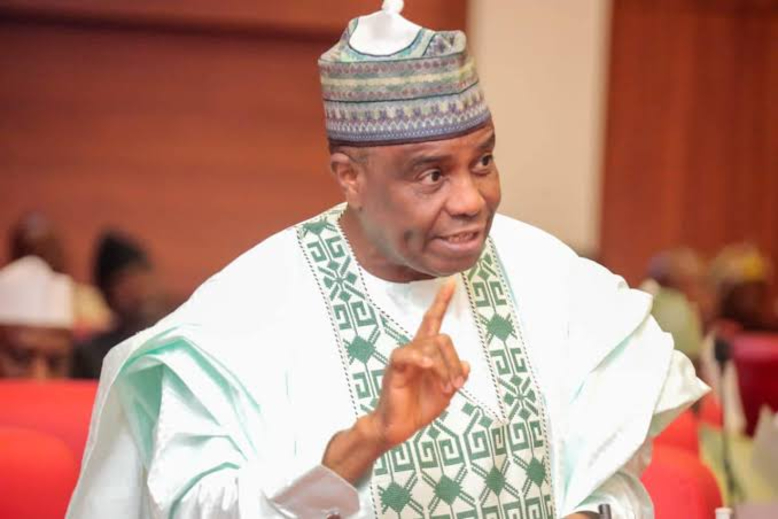
In a televised address from the State House of Assembly yesterday, Governor Abdul‑Mozaffar Tambuwal insisted that the Alliance for Development Cooperation (ADC) is “an inter‑regional partnership, not a northern agenda.” The governor’s remarks come amid growing tensions in Lagos, where southern states have accused the ADC of pressuring the federal government to divert disproportionately large shares of the 2028 budget to the north.
The Heart of the Controversy The ADC, formed in March 2025 out of a series of informal summits among fifty African leaders, is a coalition that seeks to streamline development projects across sub‑Saharan Africa. According to its charter, the group “promotes equitable resource allocation, enhances trade corridors, and facilitates knowledge exchange between African regions.” Critics, however, argue that the ADC’s focus on infrastructural projects in Nigeria’s northern states—most notably the Waja–Kanam–Maraling trade corridor in Borno—constitutes a “regional power grab.” Senate Minority Leader Emmanuel Owa, chair of the South‑East Development Committee, said in a press conference on Monday that “the ADC has been pushing for a 30‑percent increase in federal allocations to the north, sidelining the south.” Amid these allegations, Governor Tambuwal used the Senate’s platform to disavow the claim. “The ADC is not a vehicle for a ‘north‑south divide.’ Our goal is inclusive development,” he told the 300‑member assembly. “We build infrastructure so that the entire country can prosper. The success of the Waja–Kanam–Maraling corridor is a testament to our joint ability to harness resources for the common good.”
A Data‑Driven Argument Governor Tambuwal cited the latest national budget projections by the National Bureau of Statistics (NBS). The NBS released that “by 2029, the northern states are projected to receive a 12‑percent share of the total discretionary budget, up from 9 percent in 2025, a modest rise that aligns with their population growth and development needs.” Ambassador Vincent Obinna, Nigeria’s Minister of Finance, echoed Tambuwal’s argument in an interview with *The Nation* two days earlier. “The ADC’s framework is built on transparent data—i.e., GDP per capita, infrastructure deficit, and education indicators. It does not manipulate the distribution of public funds. The internal consensus is that an inclusive approach ensures national stability.” State‑level data further dispute the northern bias narrative. In Borno State, the adc‑funded irrigation scheme covering 12,500 hectares has increased agricultural productivity by 18 % and created 1,500 jobs last year alone. A Borno State Ministry of Agriculture report shows that the new irrigation network has contributed to a 9 % increase in local food self‑sufficiency.
Southern Concerns Not all voices were pacified. Chief Ashwin Kathirvel, spokesperson for the Southern Alliance for Equality (SAE), called Governor Tambuwal’s words a “political smokescreen.” “The ADC’s influence on Budget Committee 3 remains unchecked. We demand independent audit and clear disclosure of donor funding in each quarter.” The SAE is poised to file a motion with the National Assembly to compel an investigation into the ADC’s funding streams, which critics allege are predominantly supported by foreign governments with vested interests in the north’s energy resources. –
The Federal Context President Ngozi Okoye’s administration has long promoted “Balancing for Development” as a national policy. Since her election in 2023, the federal government was pushed into a fragile compromise with the North to secure the electoral support of the Borno and Adamawa constituents. In October, President Okoye signed a memorandum of understanding with the ADC to launch a “Whole‑Country Digital Infrastructure” roll‑out that will see fiber‑optic cables spliced through the Hausa‑speaking provinces, linking them to Lagos’s main data centers. “The President, like Governor Tambuwal, sees the ADC as a technical ally rather than a political adversary,” said Dr. Bolu Akinyemi, professor of political science at Ahmadu Bello University. “The central issue – and the root of the controversy – is whether an inter‑regional partnership inadvertently marginalizes the south.”
Bottom Line In statement after the address, Governor Tambuwal vowed to keep a transparent veto right over any ADC‑related initiative that could “skew the equitable distribution of resources.” The federal government has promised to “monitor the ADC’s budgetary impact through the Economic Stabilisation Council.” As the 2028 presidential election looms, Nigeria’s political landscape looks set to be a litmus test for the nation’s post‑colonial development architecture: whether architects of inter‑regional cooperation will be able to outpace the historical narrative of North‑South tension.